
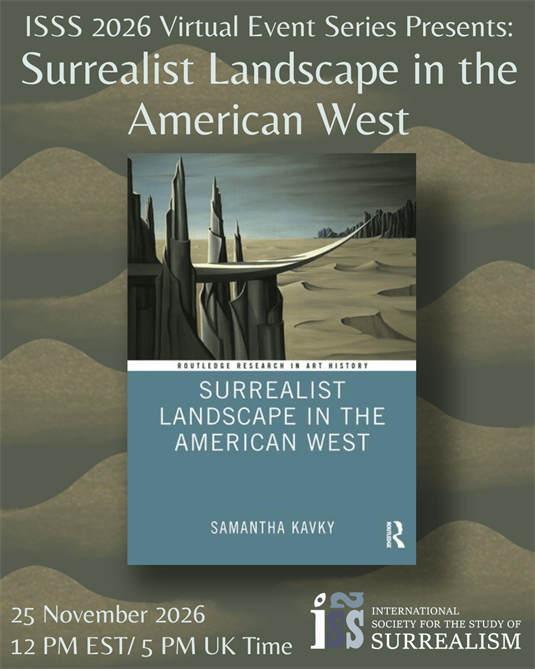
Please join us on November 25, 2026 (5pm-6.30pm, UK time) for this virtual discussion to celebrate the launch of Samantha Kavky’s Surrealist Landscape in the American West (Routledge, 2026).
You can register for the event here.
Surrealist Landscape in the American West explores the real and painted landscapes, traveled in and produced by surrealist artists in North America during the second World War. Placing these works within the larger genre of surrealist landscape painting, this study adds to the understanding of the central role played by nature in surrealist visualizations of the unconscious. Impacted by the artist’s experiences of war and exile, these landscapes shift between desolate wastelands and rich fields of mimetic camouflage, anticipating later ecological understandings of the fragility of the environment and the inter-dependency of humans and the natural world.
While surrealist landscape as a genre emerged at the beginning of the movement, its importance grew during the period of emigration in the Americas caused by the Second World War. After first converging in New York City, the surrealists fanned out, seeking connection to the natural world, exploring the landscapes of the American west in particular. Wolfgang Paalen and Kurt Seligmann traveled to the Pacific Northwest, while André Breton visited the Southwest, all drawn by their interest in the art of indigenous peoples. Max Ernst and Dorothea Tanning also traveled to the Southwest, settling in Sedona, Arizona. André Masson, Yves Tanguy, Kay Sage and Arshile Gorky gravitated to rural Connecticut, but most of them visited the American southwest at some point and almost all of these artists viewed the American western landscape through the lens of the European Romantic tradition. While exploring this topic, this study traces some of the inherent complexities between surrealist collecting practices and their anti-colonist politics, and between their embrace of Romanticism but not of Nationalism. Other paradoxes emerge especially in the work of the American women, Tanning and Sage who challenge traditional analogies between the earth and the female body. Many of the painters depicted wastelands, perpetuating the appropriation of the desert as a generic space for visionary projection, but also pointing to the devastation of the land caused by technological warfare. While others, such as Gorky and Stanley William Hayter coopted wartime camouflage as a vehicle for a dynamic psychological connection to the natural world. The book ends by positing that the surrealists’ intense engagement with nature anticipates contemporary ecocritical and post-humanist studies.
The book will be of interest to scholars working in art history, surrealism, ecocriticism, American studies, and feminist studies.
Samantha Kavky is Associate Professor of Art History at Penn State Berks, USA.
You can purchase Surrealist Landscape in the American West here.

